

B2B platform for private clinics and specialist practices
Clinical context before the consultation
Before the appointment, Inousia collects and structures the clinically relevant information a physician would otherwise gather during the consultation. This can reduce the time needed for history-taking during the consultation.
- Questions follow predefined clinical logic
- The physician stays fully in control
The problem
The first minutes of a consultation should be for clinical thinking, not data collection
In everyday clinical practice, much of what the physician needs to know only arrives during the appointment itself. Information often emerges gradually over the conversation and is structured while the patient is already in the room.
How it works
Preparation starts before the patient walks in
- Patient
- Guided questions
- Clear summary
- Physician review
-
The clinic sends a questionnaire link
Ahead of the appointment, the patient receives a link to a short questionnaire.
-
The patient answers
On their own device, at their own pace. Questions adapt to earlier answers, the specialty and the type of visit.
-
The information is organised
Answers are organised into a clear summary for physician review.
-
The physician reviews
At the start of the visit, the physician opens the summary, reviews it and confirms it with the patient.
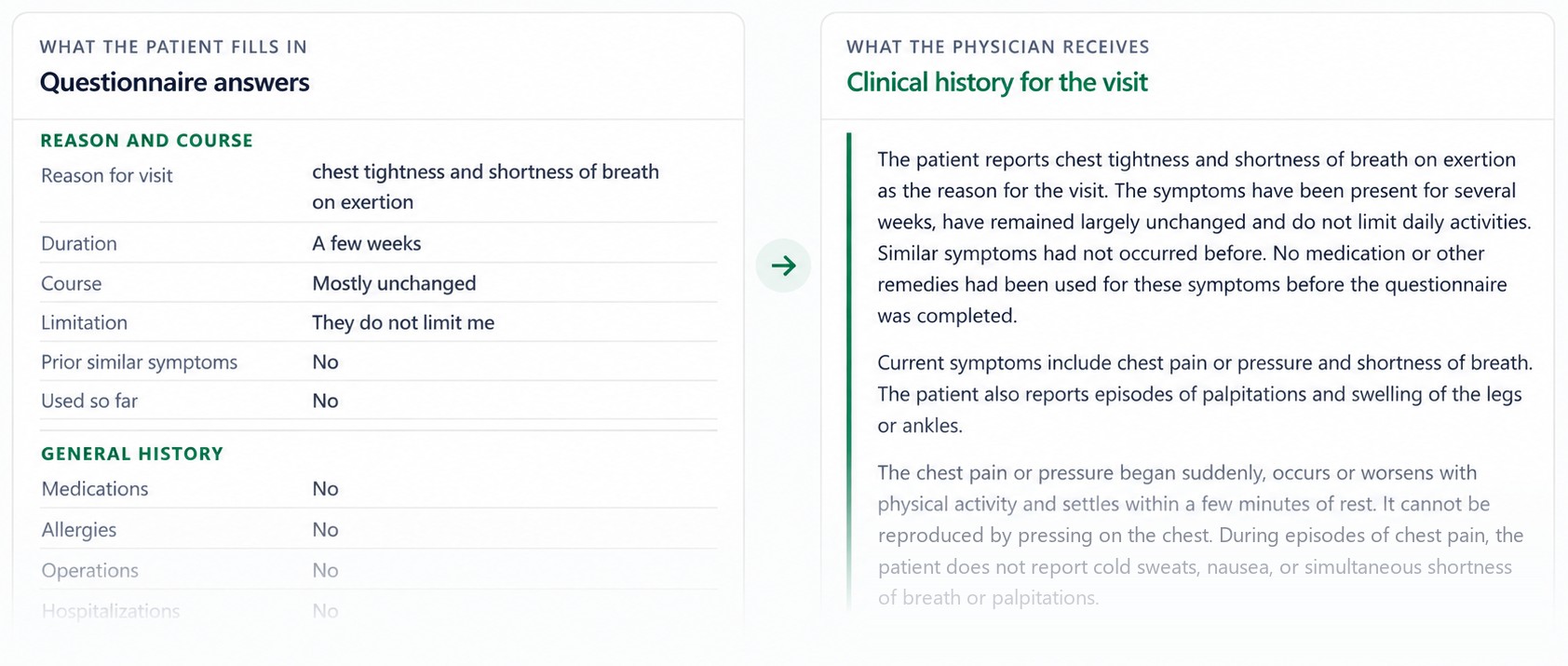
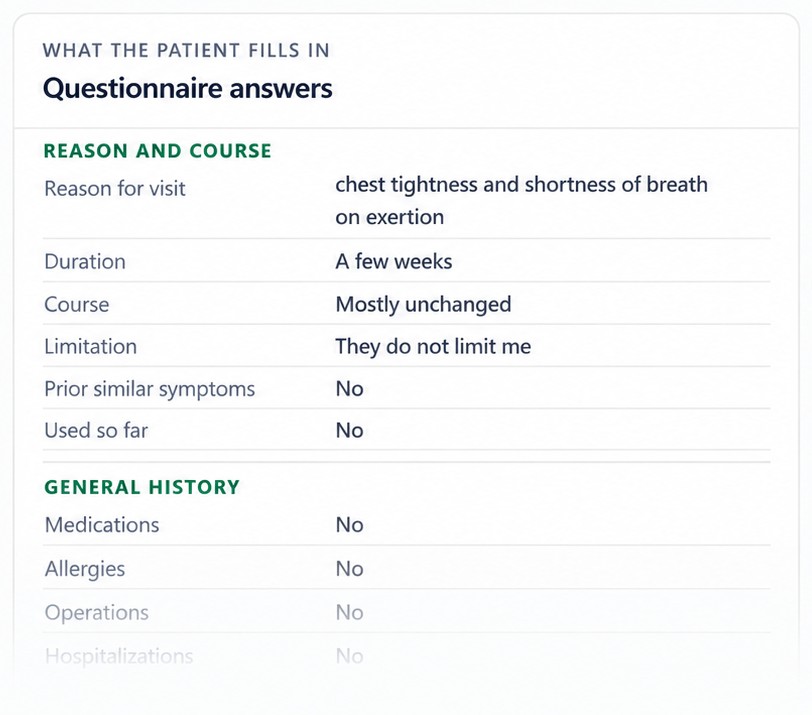
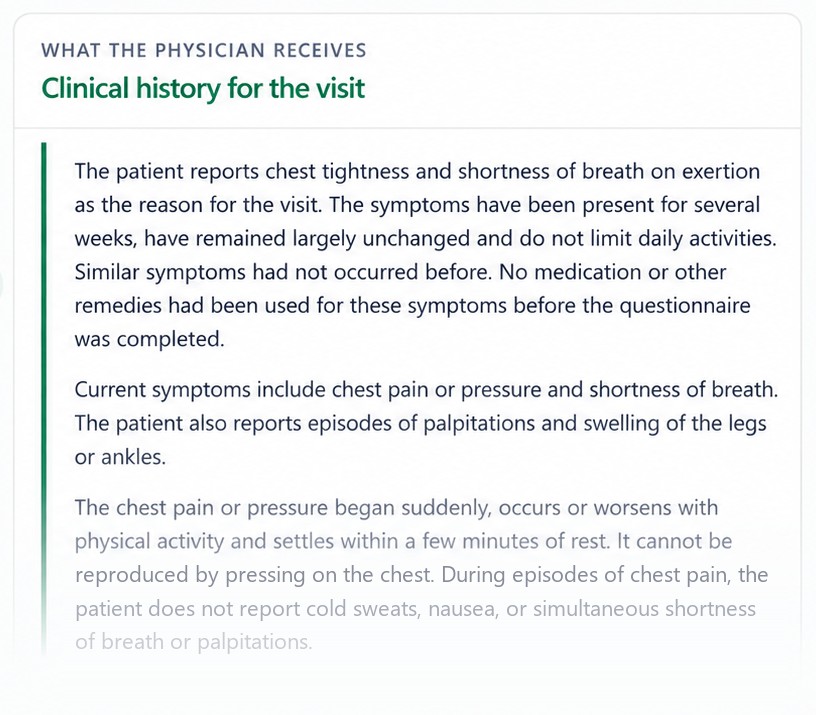
From patient answers to a clinical history ready for review
An illustrative example workflow: the patient provides the information, and the physician receives an organised clinical history before the visit.
What the physician receives
Prepared for review, not interpreted for the physician
Before or at the very start of the visit, the physician has a clear overview of what the patient reported:
- Presenting complaints
- Relevant medical history
- Current medications and therapy
- Risk factors
Different visit. Relevant questions.
Initial, follow-up and preventive visits do not require the same questionnaire
Inousia adapts the questions to the type of visit, so patients answer what is relevant to that specific appointment without unnecessary repetition.
Why Inousia
Clearly structured and under the physician's control
Predefined clinical logic
Questions and their sequence follow predefined clinical logic.
The physician decides
Inousia structures patient-reported information for physician review. It does not diagnose, recommend treatment or make clinical decisions.
Based on patient answers
The summary is based on the information the patient entered in the questionnaire.
Fits existing workflows
No complex integration with existing systems is needed to begin.
For clinics
What changes for everyone in the appointment
For the clinic
- A more consistent way of taking patient history across the clinic
- Relevant clinical information available before the visit
- The potential for shorter consultations and more efficient use of clinical capacity, with part of the history-taking prepared in advance
For the physician
- A clear overview before or at the very start of the visit
- Less time during the visit spent gathering history, with more room for clinical assessment
- Interpretation and clinical decisions stay with the physician
For the patient
- A short, guided questionnaire on their own device
- Questions tailored to the specialty and type of visit: first, follow-up or preventive
- More room during the visit to talk and ask questions
Data protection
Sensitive health data deserves serious protection
Inousia is developed with technical and organisational measures designed to protect sensitive health data and support compliance with data protection requirements.
Who it's for
Designed for private clinics, polyclinics and specialist practices
Development status
Functional product prototype. Preparation is underway for workflow validation in private clinics and specialist practices.
Languages
English and Serbian. Additional languages are planned.
Scope
Inousia structures patient-reported information for physician review. It does not provide diagnosis or treatment recommendations, and does not replace clinical judgment.
FAQ
Frequently asked questions
Does the patient need to install an app?
No. The patient accesses the questionnaire through a link on their own device.
Is the questionnaire the same for every visit?
No. Questions adapt to the specialty and type of visit — initial, follow-up or preventive.
Does AI create the clinical history or summary for the physician?
No. AI is not used in this module. The summary is generated from the patient's answers and predefined clinical logic, without interpretation, clinical inference or diagnosis.
Is integration with the clinic's existing system required?
Integration is not required to get started. Inousia can operate independently, while integration can be planned around the clinic's needs.
How is patient data protected?
Inousia is developed with technical and organisational measures designed to protect sensitive health data and support compliance with data protection requirements.
Contact
See how Inousia fits into your clinical workflow
Inousia is currently speaking with private clinics, specialist practices and healthtech partners. Request a short walkthrough of the product.